


On April 12th—exactly 56 days from now (haha!)—Hungary will hold its general elections. Since the fall of communism in 1990, this has been our four-yearly ritual of multi-party competition. Our politicians like to call it the “celebration of democracy.”
Hungary is a young democracy. When the communist system collapsed, well-intentioned but perhaps slightly naive intellectuals orchestrated a completely bloodless transition. It’s respectable, really—sitting at a “Round Table,” reaching a consensus to achieve what cost other neighboring countries immense tension or even civil war. Back then, Hungary was the “star pupil” of the region. We cut the Iron Curtain, paving the way for German reunification, and our communists were among the first to allow market-oriented economic reforms. We were the “good guys.” This was reinforced by reviving a medieval tradition: the high-level Polish-Czech-Hungarian cooperation known as the Visegrád Group (V3), named after a famous 1335 royal summit. (When Czechoslovakia split, the Slovaks joined, making us the V4.)
The Congress of Visegrád (1335): A diplomatic summit convened by King Charles I of Hungary, with King John of Bohemia and King Casimir III of Poland. It ended hostilities between Poland and Bohemia and created a lasting alliance and trade cooperation between the three kingdoms. – Wikipedia
The “Deep Water” Syndrome
The 1990s carried this initial wave of optimism. We were living through Fukuyama’s “End of History”: the liberal world order had won, and it was supposed to be sunshine and rainbows from then on. Except, not everyone in Hungary felt that way. Many became the “losers” of capitalism.
Imagine a country that spent the previous century teaching its citizens that the state takes care of everything and that individual autonomy is suspicious and dangerous. This society was suddenly thrown into the deep end: “Swim! From now on, you alone are responsible for your fate and your livelihood.” As it turned out, a huge portion of Hungary didn’t know how to swim. Those who could made it to the “island of the happy,” becoming successful and adopting Western ways of living and thinking. Society split in a way we hadn’t seen before.
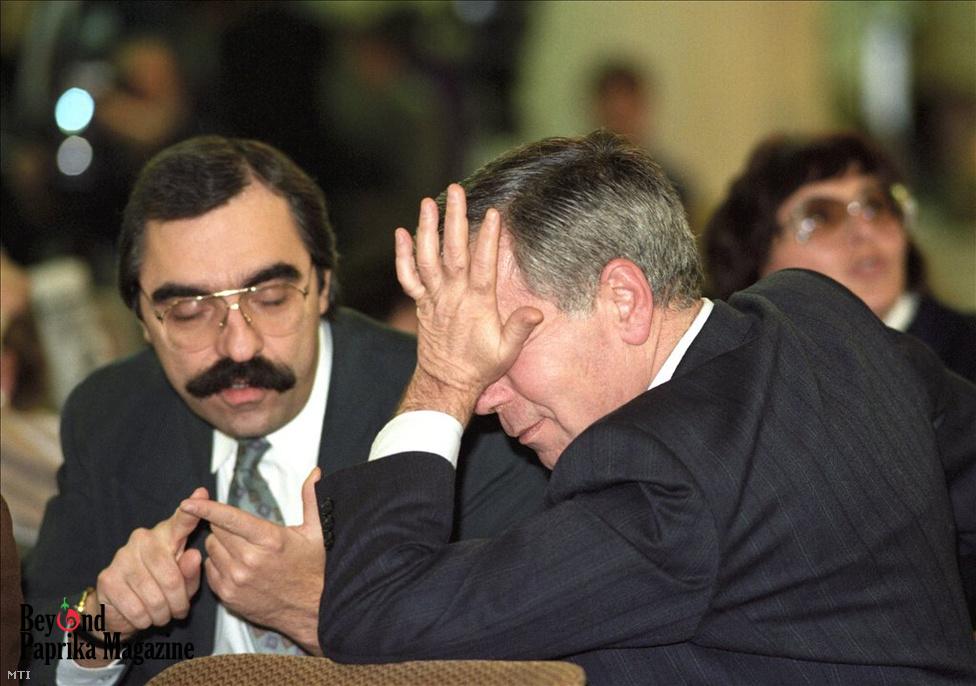
(Photo: László P. Balogh / MTI)
Why this photo matters
To a casual observer, this is just two tired men in suits. To a Hungarian, this image is the visual definition of “no way out.”
On the left, with the thick mustache and intense gaze, is Lajos Bokros, the Minister of Finance. On the right, buried in his palm, is Prime Minister Gyula Horn. The year is 1995, and Hungary is on the brink of economic collapse.
Bokros is the architect of the infamous “Bokros Package”—a series of brutal austerity measures designed to save the national budget. It worked, but at a massive social cost. For a society just learning to “swim” in capitalism, it was a cold, violent wave. To this day, the name “Bokros” remains a shorthand for painful economic sacrifice in the Hungarian vocabulary.
This photo captures the exact moment the “optimism of the 90s” met the harsh reality of the checkbook. It’s the face of a young democracy realizing that freedom isn’t free—it’s actually very, very expensive.
This was reflected in our elections. By the late ’90s, a massive bipolar system emerged. On one side, the successor to the Communist Party (MSZP) represented a sort of Blairite social democracy. On the other, a youth party that started out liberal—Fidesz (Alliance of Young Democrats)—quickly pivoted to the center-right, becoming a massive “catch-all” party in tandem with the Christian Democrats.
The Road to Polarization
By the 2000s, the rotation of power stalled, and the socialists led for two consecutive terms. We joined NATO and the EU, but Hungary was already drifting off the path of liberal capitalism. Social tension and polarization grew, much like what we see in the US today. The “national minimum”—the possibility of compromise—vanished. This was everyone’s fault, but Fidesz, labeling themselves as conservatives, worked the hardest at it.
Hungarian society began to long for older systems that offered less responsibility and more dependency. A strange cocktail emerged: a right-wing ideology named after the pre-WWII Governor Miklós Horthy, mixed with a nostalgia for the “consolidated” (safer) era of the communist Kádár regime. It was—and is—a state of political schizophrenia. Ideologies became fluid: leftists spat conservative slogans, while the right-wing took on socially sensitive, populist themes.
Then came 2006, the biggest political scandal since the regime change. The Socialist Prime Minister, Ferenc Gyurcsány, admitted in a leaked internal speech that they had lied about the state of the economy just to win the election. His phrasing—“We fucked up. Not just a little, but a lot“—became an instant, infamous catchphrase. He didn’t resign, leading to months of violent protests, burning cars, and clashes between riot police and demonstrators.
![Photo: Béla Szandelszky / AP - from the book Túlkapások [Excesses]](https://oriandras.net/wp-content/uploads/2026/02/2006-vizagyuk.jpg?v=1771175497)
The Rise of the “Star Pupil” Autocracy
In 2010, Fidesz and Viktor Orbán won a landslide two-thirds majority. They immediately began dismantling the old order. They rewrote the Constitution into a hollow framework, symbolically renaming the country from the “Republic of Hungary” to just “Hungary.” It was an omen.
Then came the gerrymandering, the nationalization of private pension funds, and the building of a system modeled after Putin or Erdoğan—though Orbán soon went from being a student to a professor of the craft. The modern American MAGA movement relies heavily on techniques pioneered by Orbán’s team to “hystericize” society. A media landscape that is either suppressed or branded as “fake,” state institutions led by oligarchs—we were the pioneers.
The Turning Point: A Ghost from the System
The progressive and liberal opposition fractured into irrelevance. Meanwhile, Hungary slipped from being a regional leader to the back of the pack. Our diplomacy turned toward Russia and China, our economy became a vassal to the German car industry and later Far-Eastern battery factories. Innovation withered, and then Covid-19 delivered the final blow. Huge inflation followed, and the Central Bank governor was accused of literally funneling national wealth into his family foundations.
Despite this, Fidesz won again in 2022. The opposition sank into apathy; people like me, who believe in liberal values, gave up hope.
But then, like a plot twist in a dark fairy tale, the remaining independent press dealt a massive blow: it was revealed that the President had pardoned an accomplice in a child abuse case. This hit a nerve even in our apathetic society.
Political context: In Hungary, the Prime Minister holds the real power. The President is a ceremonial role, elected by Parliament. Lately, the President has been a direct loyalist of the ruling party.
The President and the Justice Minister resigned. In the heat of the public outrage, an interview went viral on Partizán (Hungary’s largest independent YouTube channel, funded solely by viewers). The interviewee was Péter Magyar, the ex-husband of the resigned Justice Minister. An insider, he exposed the true nature of the system and promised evidence.
By March, he was leading a massive movement. He founded the Tisza Party (Respect and Freedom Party—”Tisza” is the name of Hungary’s second-largest river and also the surname of a famous PM from the Austro-Hungarian era). In the 2024 EU elections, he wiped out the old opposition and came neck-and-neck with Fidesz.
“Cutting the Tape”
This sounds great, right? But there are catches. Fidesz has built a “state-party” that can manipulate elections at will. Plus, Tisza rejects almost everyone who has been in politics for the last 20 years—ignoring the fact that they themselves came from within Fidesz.
Still, for the first time in 16 years, the stakes are real. Orbán’s camp wants to continue drifting away from the West; a victory for them might mean Hungary leaving (or being kicked out of) the EU. For those opposing Orbán, Tisza represents the only hope to “swerve the wheel” at the last second in this game of chicken.
Life in Hungary has essentially paused. No one is making big moves; everyone is waiting to see which way the wind blows. This helpless waiting creates a terrible daily tension. Péter Magyar has been counting down the days since last summer, ending every speech with: “We only have to endure this many more days.”
So, that’s why we’re all counting. Some fear for the life they know; others are desperate for the change they’ve waited a decade for.
As we say in Hungary: we are “cutting the tape” (vágjuk a centit)—the way soldiers used to cut a centimeter off their measuring tape every day until they were finally discharged.
Cover photo: Papajcsik Péter / Index